





Securium Academy — In Association with EIMT University (Swiss)

Master of Computer Science (Cybersecurity) — SWISS. Recognized Degree • 100% Online • EIMT Certifications Included

Cybersecurity is no longer just an IT function, it has become one of the world's most critical business priorities. From multinational organisations and financial institutions to governments and healthcare providers, every sector relies on professionals who can protect digital assets, manage cyber risks, and defend against increasingly sophisticated attacks. As artificial intelligence, cloud computing, and connected technologies continue to transform industries, the demand for highly qualified cybersecurity experts continues to grow across the globe.

1.5
Years Program
100%
Online Learning
1
EIMT Certifications
Student 1 Student 2 Student 3 Student 4
Global Network of Cyber Security Graduates
Start Your Research Journey

Request Program Details

Speak with our admissions team about the online Doctorate in Computer Science.

Solve: 3 + 4 = ?

Accreditations

Dedicated to Quality, Committed to Your Success.

EAE

USDLA

EURASHE

ACBSP

AQS

QAHE

Accreditation

EAE

USDLA

EURASHE

ACBSP

AQS

QAHE

Accreditation

Program Highlights

Bachelor of Science in Cyber Security — A U.S. recognized, 100% online degree designed to build technical expertise, leadership skills, and real-world cyber defense capabilities.

Accreditations

Accredited by major accrediting bodies.

Alumni Network

A strong network of 1000+ alumni worldwide.

Scholarships

Up to 30% of the total tuition fees available.

International Students

From 20+ countries.

Industry Mentorship

Learn directly from experienced cybersecurity professionals.

Career Support

Placement assistance, career guidance, and professional development.

Why Choose This Program?

Master's of Science in Cybersecurity

The program is designed to provide students with a comprehensive understanding of cybersecurity principles, practices, and technologies. It equips students with the skills needed to protect organizations from cyber threats and to manage security risks effectively.

Strong Cybersecurity Foundation
The curriculum covers advanced security engineering, post-quantum cryptography and cloud identity architecture right from the start, not as an afterthought.
Practice-Led Learning
Every module is assessed through real system setups, coding projects and research work, so you're proving your skills, not just memorising theory.
Learn From Industry-Experienced Cybersecurity Experts
Study under professionals with extensive experience in cybersecurity, from managing large-scale cyber incidents and securing cloud infrastructures to leading enterprise security teams.
A Clear Path From Basic To Expertise
Develop a strong foundation in networking and secure software development before progressing to advanced cyber defence, threat detection, and incident response.
Flexible Learning
Study through recorded lectures and get regular feedback from mentors on your lab work, all without leaving your job.
Finish Master's Degree in 18 Months
Complete your full postgraduate degree, including your final security project, in a year and a half.
30 ECTS Industry-Driven Capstone Project
Undertake a substantial research and development project that enables you to apply advanced cybersecurity concepts to solve complex industry challenges.
Future-Ready Skills For The Global Job Market
Develop expertise in high-demand areas such as AI security, malware analysis, digital forensics, cloud security, and automated incident response.
Global Learning Without Relocation
Earn an internationally recognised qualification through a flexible online learning experience designed for professionals worldwide.
Apply Now View Program Details
100%
Online Learning
18 Months
Degree Program
DCS Program
EIMT University
Master's of Science in Cybersecurity
100% Online Degree

Learning Outcomes

  • Evaluate Advanced Computing Principles: Review complex data structures and algorithmic theory to solve heavy computational problems. This threshold knowledge helps select the most efficient processing methods for intense software tasks.
  • Design Intelligent Data Models: Build, test, and validate machine learning scripts and deep neural networks independently. These custom models are designed specifically to handle automated problem-solving across modern industries.
  • Construct Scalable Cloud Pipelines: Engineer stable, reproducible data flows and analytics frameworks using distributed networks. This practical expertise helps manage massive corporate data storage without facing system performance lag.
  • Apply Statistical Reasoning Metrics: Utilise probability logic and data sampling rules to measure system uncertainty and errors. This mathematical practise allows professionals to back up final conclusions with clear, verifiable numbers.
  • Deploy Automated Production Systems: Launch, track, and manage working artificial intelligence networks within active corporate environments. Monitoring ongoing performance ensures platforms constantly meet strict criteria for reliability and speed.
  • Appraise Technology Governance Laws: Examine the legal rules, social impacts, and data privacy boundaries surrounding automated software. This training teaches specialists to spot database bias and maintain global compliance standards.
  • Conduct Independent Research Studies: Plan original technical investigations by reviewing scientific literature and finding open technology gaps. This preparation allows engineers to share practical findings clearly with academic and corporate audiences.
  • Operate with Professional Autonomy: Manage complex technical tasks independently while adapting smoothly to changing workplace trends. This experience builds the leadership resilience needed to run enterprise software development teams.

Graduates emerge with both technical expertise and strategic cyber defense knowledge.

Individual Study Plan | Practitioner Based Project/Dissertation:

The primary goal for prospective scholars is drafting their research proposal. This proposal can be an 8–10 page document that consists of essential factors of the DCS program. Our pre-defined template will facilitate an easier and quicker process of documentation. Students are advised to keep their initial research proposal ready within the first month of enrolment and submit it. You will receive feedback and guidance on your Research proposal from your designated supervisor or Research Faculty. The template for your preliminary research proposal can be found here.

One can consider the following points while selecting his/her topic for the research project.

  • In-depth research on a single subject assessing a novel or inventive intervention, technical answers etc.
  • An evaluation of a program and an action research or participatory action research study
  • A field investigation that looks at theoretical conceptions;
  • A survey study looking at beliefs, attitudes, or behaviors within a subject matter or discipline.
  • As an enhancement to a business process.

As the pointers reflect, the doctoral degree program requires extensive knowledge of the literature about the particular subject areas and sophistication of how a project is developed and presented. These projects enhance students' experience and equip them to develop expertise in their specialization and prepare them to be competent practitioner-scholars. To achieve this goal, students are recommended to pursue a topic in which they already have extensive practical experience.

Practitioner Based Project
Individual Study Plan
Important Information Regarding Master of Computer Science (Cybersecurity) Program

Program Delivery

The program is delivered entirely online, with hands-on cybersecurity laboratories, practical assignments, and real-world case studies integrated throughout every module.

The early modules focus on sharpening your technical skills, system configuration, and leadership in defensive security. The final stretch is set aside for your master's capstone project where you plan it, build it, and present it, under the supervision of an assigned faculty member.

Professional Professors

Industry Leaders and Faculty Members

The program is delivered by experienced cybersecurity professionals and distinguished academics who bring extensive industry knowledge into the classroom. Drawing on practical experience in cyber defence, cloud security, incident response, and enterprise risk management, they provide insights that reflect today's rapidly evolving digital landscape.

Learners benefit from industry-relevant guidance, practical feedback, and real-world perspectives throughout their studies. EIMT also collaborates with leading technology experts, researchers, and experienced faculty members to ensure the curriculum remains current, industry-aligned, and focused on the skills employers value most.

Program Delivery

Admission Requirements:

To apply for this program, you need a bachelor's degree in computing, engineering, mathematics, or a similar discipline from a recognised institution. Relevant professional experience or prior learning may also be considered under the Recognition of Prior Learning (RPL) Policy.

Language Competence:

All the modules in this program are taught in English. Non-native speakers must show proof of their language abilities before starting. The institute accepts an IELTS score of 6.5 or a similar official certificate. This test is not required for individuals who finished high school or university studies entirely in English.

English Language Waiver:

The English test score is not required for applicants who meet any of these criteria:

  • The applicant is a native English speaker
  • The applicant finished high school or college education in English
  • The applicant has worked for at least two years in a company where English is the main language.

Application Process

Applications are accepted online only. Admission is competitive, based on prior attainment and demonstrated creative-technical ability. Once received, our team reviews your academic background and portfolio and will contact you directly regarding next steps.

What is Next?

Once the Admissions Committee reviews your application and confirms eligibility, you'll receive a letter of admission. After payment is processed, you'll receive your login credentials and access to EIMT's Learning Management System.

  • All students enrolled in the Master of Computer Science (Cyber Security) programme at EIMT shall also be simultaneously enrolled in the corresponding “Master of Computer Science (Cyber Security)” programme offered by the Euro American Institute, Malta.

The Curriculum

The curriculum for Master of Computer Science (Cybersecurity) follows a planned 90 ECTS credit structure. Students take 12 core modules that are worth 5 credits each. After gaining this deep technical knowledge, you will progress to the final capstone project (30 credits) to wrap up your degree.

Core Modules

60 ECTS

MCSC701:

Security Engineering (5 ECTS)

This foundation module covers core data protection principles, asset tracking, and threat modelling techniques using structural STRIDE methods. Students write clean code to configure secure operating system baselines and build secure design patterns. The course focuses majorly on handling privilege levels, applying system access controls, and reviewing architectural risk.

MCSC702:

Computer Networks and Protocol Security (5 ECTS)

Students look into network layer models, protocol encapsulation rules, and layered architecture vulnerabilities across corporate systems. The module guides you through configuring firewall rules, setting up virtual private networks, and analysing live packet streams. Every week focuses on identifying routing threats, managing TLS handshakes, and deploying network telemetry monitoring.

MCSC703:

Operating Systems and Systems Security (5 ECTS)

Developing deep operating system architecture expertise forms the main goal, starting with binary arithmetic straight into memory segments of the program. Students examine running process layouts, explore kernel privilege level boundaries, and track system calls in virtual environments. This module enables students to detect memory corruption errors and allow platform mitigation such as secure boot.

MCSC704:

Applied Cryptography and Post-Quantum Migration (5 ECTS)

This module covers symmetric and asymmetric primitives, encryption mechanisms, and key derivation functions. Students practise in running a certificate authority, performing public-key configurations, and handling full lifecycle of keys. Subsequent weeks focus on post-quantum cryptography threats, post-quantum cryptography algorithms benchmarking, and designing corporate infrastructure for flexible cryptography migration.

MCSC705:

Cloud, Identity and Platform Security (5 ECTS)

In this module, students focus on learning shared responsibility models, cloud identity access management policies, and zero-trust identity architecture. Here, students get practical experience in auditing permission sprawl, securing container images, and developing guardrails using policy-as-code. The course ends with multi-account landing zone governance, software bill of material generation, and protection of serverless infrastructures.

MCSC706:

Governance, Risk, Compliance and Audit (5 ECTS)

The module begins with information security management systems, corporate risk frameworks, and steps for drafting policy hierarchies. Here, students will learn about ISO 27001 requirements, NIST Framework mappings, and global data privacy regulations. In the later stages of the module, the emphasis is on assessing supply chain risks and conducting risk-based audit planning and reporting.

MCSC707:

Secure Software and Data Security (5 ECTS)

This module introduces defensive programming foundations using the Java runtime environment model to validate untrusted input streams. You will practise object-oriented design isolation, safe data serialisation, and secure relational database schema design. The course finishes by exploring parameterised SQL queries, database role access controls, and automated software testing tools.

MCSC708:

Penetration Testing and Offensive Security (5 ECTS)

Through this module, students learn to map attack surfaces using passive reconnaissance tools, network scanning, and vulnerability enumeration techniques. Students use authorised hacking frameworks to gain initial access, escalate local privileges, and pivot through target networks. The module covers web application API attacks, persistence tracking, and structuring professional penetration test reports.

MCSC709:

Security Operations, Detection and Incident Response (5 ECTS)

This operational module builds capabilities in SIEM platform query development, log data normalisation pipelines, and threat intelligence tracking. Students map malicious intrusions to the MITRE ATT&CK framework and author automated detection engineering rules. The training path finishes by executing incident response playbooks and managing crisis communications during simulated breaches.

MCSC710:

Malware Analysis and Digital Forensics (5 ECTS)

Students learn to triage harmful computer bugs inside isolated sandbox lab rooms using static and dynamic analysis tools. The course covers file header inspection, YARA rule signature authoring, code disassembly, and anti-analysis evasion bypass steps. Students also master volatile memory acquisition, forensic disk imaging, and reconstructing timeline artefacts for expert testimony reports.

MCSC711:

AI Systems Security (5 ECTS)

This cutting-edge module covers machine learning attack surfaces, adversarial evasion tactics, and training dataset poisoning protections. Students demonstrate model extraction flaws and mitigate prompt injection bugs inside retrieval-augmented generation tools. The curriculum integrates a strong focus on agentic tool constraints, model provenance verification, and structured AI red teaming methodologies.

MCSC712:

Advanced Computing Research Methods (5 ECTS)

This module teaches students to frame clear computing research questions, conduct systematic literature reviews, and design empirical experiments. You will practise qualitative coding analysis, descriptive statistical math testing, and research data management plan writing. It ends with research ethics governance, coordinated vulnerability disclosure rules, and formal academic proposal development.

Capstone Project

30 ECTS

MCSC713:

Capstone Project (30 ECTS)

In the capstone project, students spend a dedicated period of time looking into a specific cybersecurity problem under expert supervision. They conduct a critical literature review, formulate an architectural methodology, and build a working defensive application or tool independently. This final portfolio work allows students to validate their solution against success metrics and defend findings during an oral defence in front of the panel.

Academic Partnership

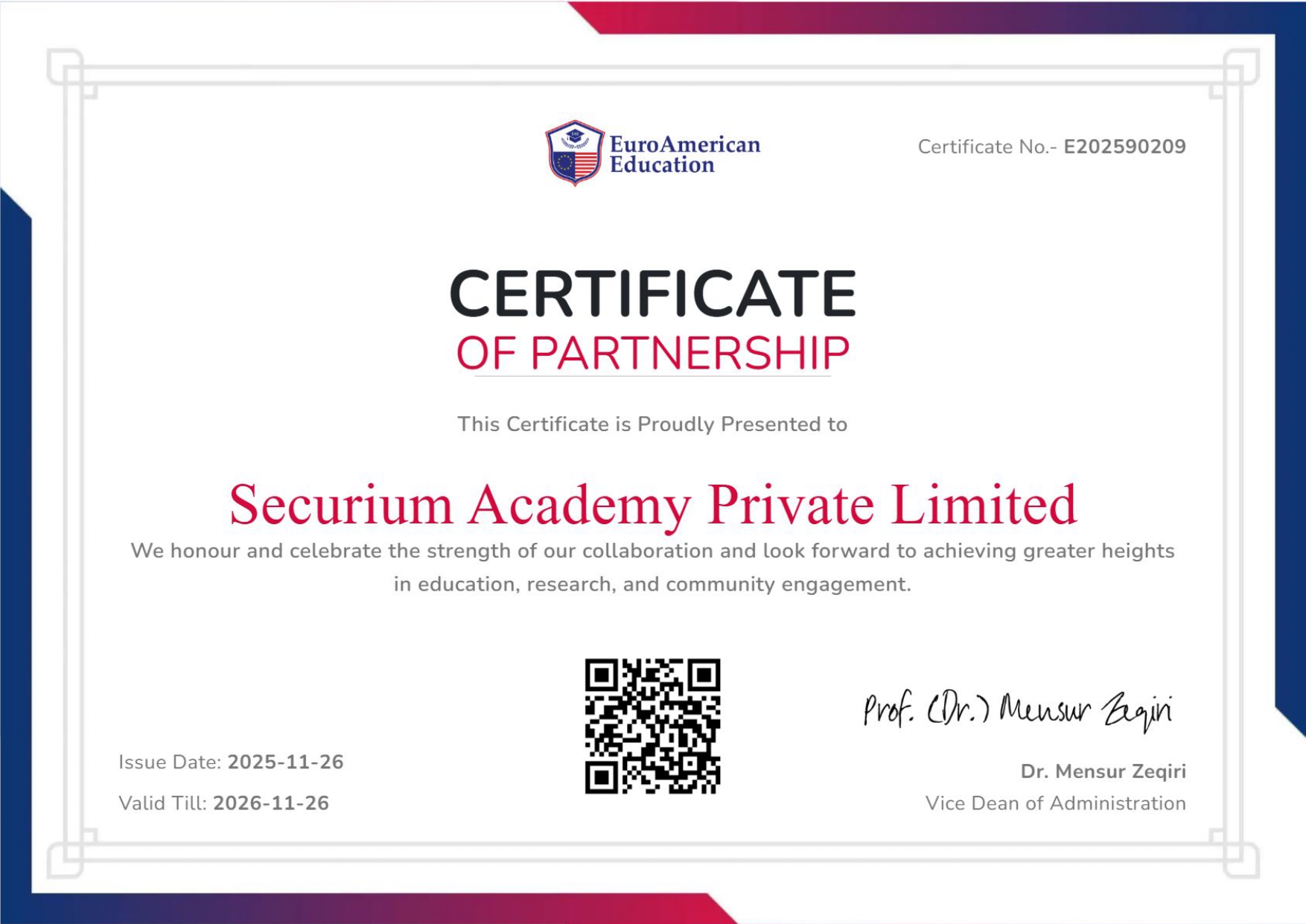
Securium Academy x EIMT

A globally significant academic partnership bringing world-class cybersecurity education to professionals everywhere.

Why This Partnership Sets a New Standard

Securium Academy brings cutting-edge curriculum design, industry mentorship and career support. EIMT contributes EU accreditation, global recognition, and the academic rigour of the European Higher Education Area. Together, they deliver a master's degree that opens doors internationally.

  • EIMT is an EU chartered institution regulated by MFHEA Malta
  • Degree recognised across 60+ countries in the EHEA
  • Securium Academy provides industry-led curriculum and mentorship
  • Global alumni network across 130+ countries
  • Career support, placement assistance, and LinkedIn coaching
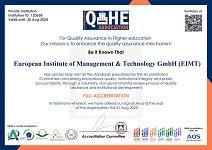
EIMT Certification

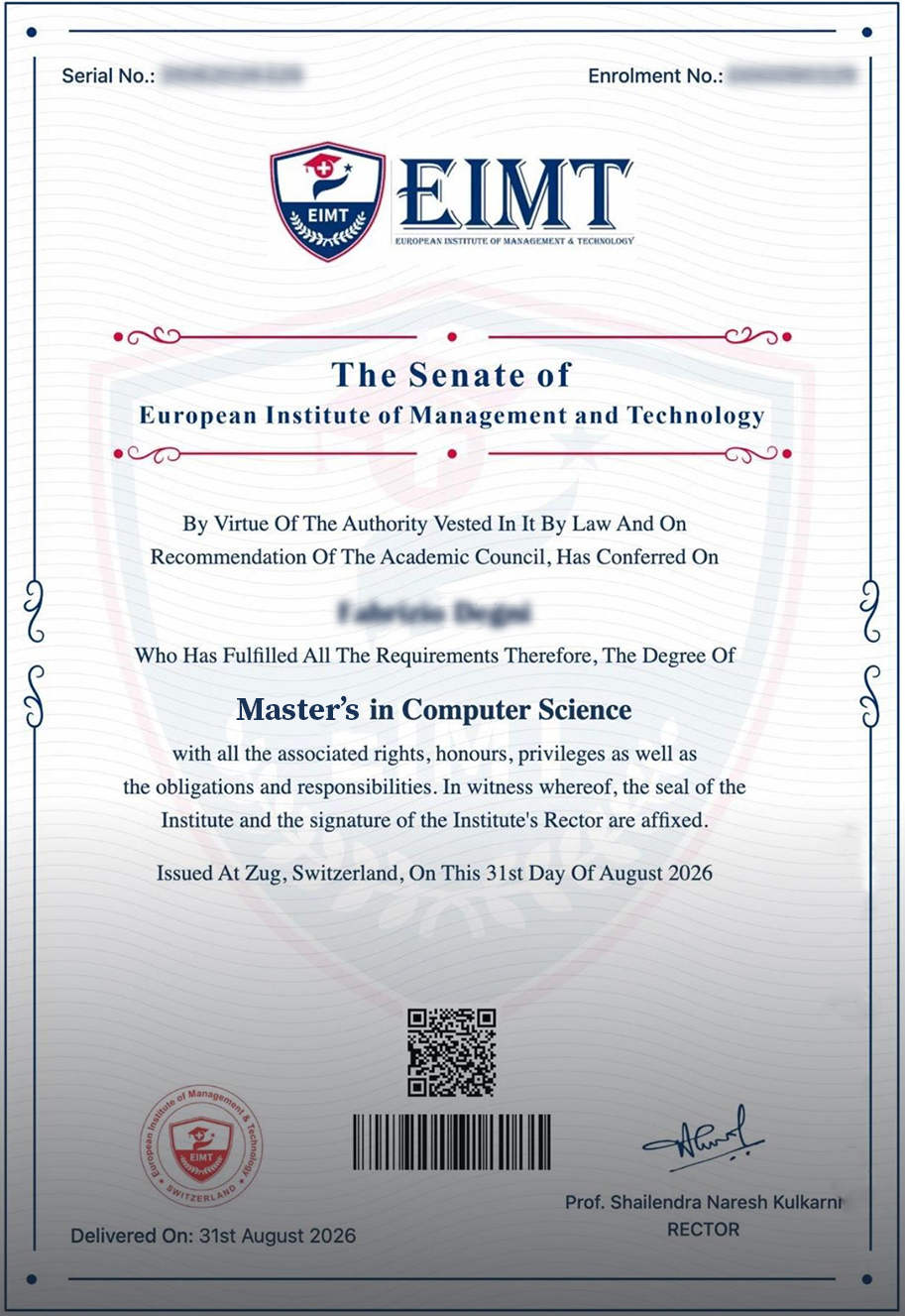
Sample Certificate from EIMT

  • Fully Accredited and Recognized Degrees
  • Multidisciplinary and Comprehensive Approach to Learning
  • Globally Recognized Degree
  • Highly Experienced Faculty
  • Structured Schedules
Official Sample
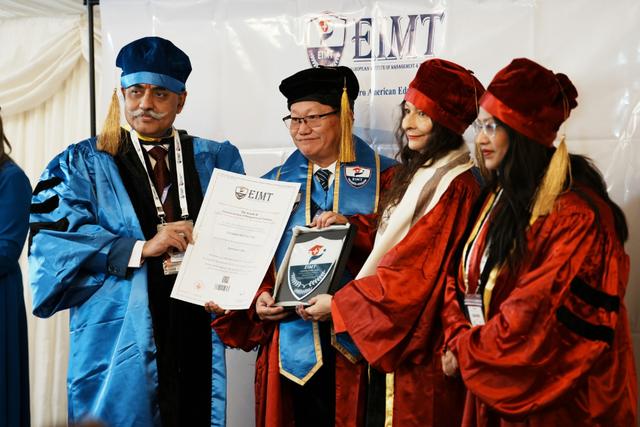
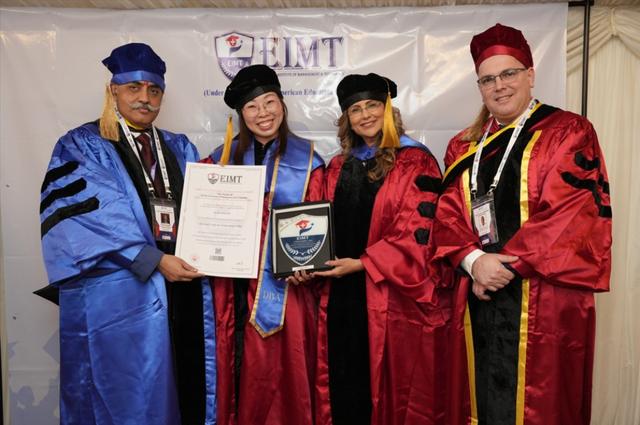
EIMT Gallery
Testimonials

Video Testimonials

Discover how an EIMT degree has transformed careers straight from the voices of our learners.

Frequently Asked Questions

Master of Computer Science (Cybersecurity) is a 18 months 90 ECTS Online master's program provided by EIMT that is centred around network defence, applied cryptography, cloud security and incident response ending with a capstone project.

The applicants should possess a bachelor's degree in computing, engineering, mathematics or a related field. Those without this background may still qualify through EIMT's Recognition of Prior Learning policy if they have demonstrable programming experience.

The program takes a minimum of 18 months and offers 90 ECTS credits upon graduation, including the capstone project. Due to its flexibility and online format, it is designed precisely for working professionals, meaning that the duration takes into account your work-life balance without having to pause your career. The enrolment is continuous all year round, which means that students can start the program without waiting for the next intake.

Yes. All modules will be offered in online format through recorded lectures, virtual labs, and mentor’s feedback, which means that you can study remotely without relocating.

For students whose first language is not English, an IELTS test of 6.5 is required. The test will be waived for students who have completed their studies in English, are native speakers, or have at least two years of experience in an English-speaking environment.

The mandatory modules include security engineering, security of network protocols, security of operating systems, applied cryptography, cloud and identity security, governance and compliance, security software development, penetration testing, security operations, malware analysis, and AI systems security.

Students are using industry-standard tools, like Kali Linux, in virtual laboratories for performing network analysis and penetration tests. In addition, these sandboxed labs also let students safely observe behaviour of malware and perform traffic analysis. Using the same tools that are used in real security operations centres assists in transferring knowledge gained from labs into the working environment.

In the capstone project, students identify a real cybersecurity issue, develop an actual defensive tool or application on their own, and then present their results in front of the panel members. It accounts for 30 out of 90 total ECTS credits, making it the single largest component of the whole degree program. The project is completed under the supervision of an assigned faculty member, moving from initial planning through to a fully built and presented solution.

After completion of the degree program, you are prepared for senior cyber security positions with a focus on defending the networks, responding to incidents, cloud security, pen testing, and cybersecurity leadership. Also, the combination of technical and governance-oriented courses makes the graduates ready for jobs such as security auditing and risk management. The capstone project and lab portfolio allow the graduates to demonstrate their skills after graduation.

Yes, since the program is very flexible and it allows you to study online. It enables you to apply new skills at work while completing coursework alongside your jobs.

Cybersecurity continues to be a highly demanded profession. According to the Bureau of Labor Statistics, security analyst roles are set to increase by 29% through 2034, which significantly exceeds the national average. This means that there are thousands of new positions opening every year due to the lack of skilled cybersecurity professionals worldwide. A properly designed postgraduate degree will allow you to prove your real-life skills rather than just your theoretical knowledge.

A master's degree offers comprehensive theoretical and practical learning across a full academic curriculum, supported by recognised academic credits. In contrast, professional certifications typically validate narrower, role-specific skills more quickly but do not provide the same breadth, depth, or academic rigour.

For this master's degree program, it is beneficial to have a basic understanding of programming, as the curriculum includes modules on secure software development, coding, and software security.

Request More Details

Solve: 3 + 4 = ?
Enter the result of the math question above.
×

Book Demo

×

Connect With Expert

Solve: 3 + 4 = ?
Enter the result of the math question above.
Connect With Expert
×

Apply Now

Solve: 3 + 4 = ?
Enter the result of the math question above.
×

Apply Now

Solve: 3 + 4 = ?
Enter the result of the math question above.