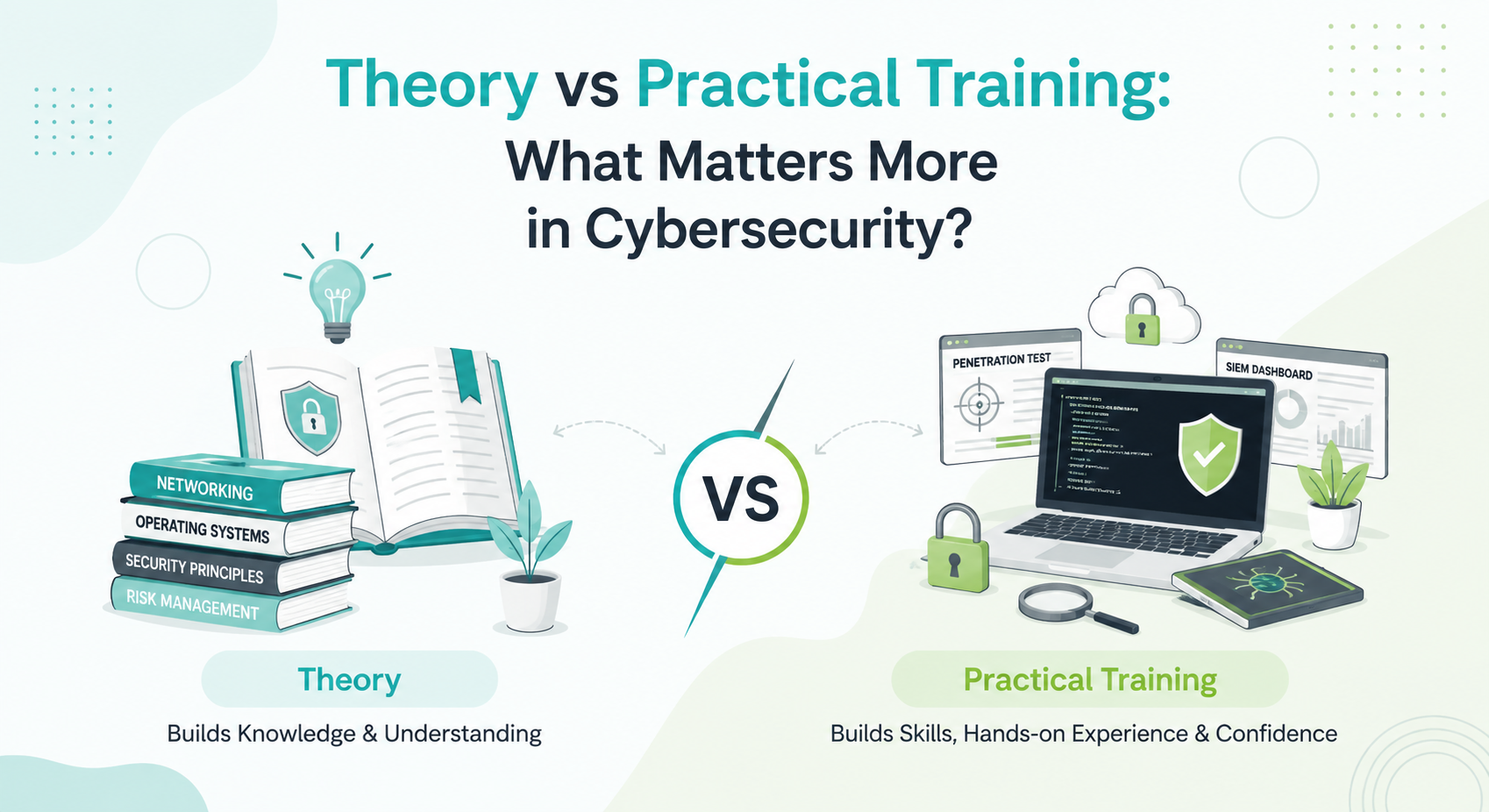
Cybersecurity is one of the growing fields in technology. As cyber threats become sophisticated organizations need professionals who understand both cybersecurity concepts and practical security techniques. This raises a question: Is theory or practical training more important, in cybersecurity?
The answer is simple: both are essential. Practical training turns knowledge into real-world skills.
Understanding Cybersecurity Theory
Cybersecurity theory is the foundation that I need to understand how security works. Cybersecurity theory covers ideas such, as network security, cryptography, vulnerability management, risk assessment, access control, malware and security frameworks.
For students preparing for certifications such as CompTIA Security+, CompTIA Network+, CompTIA Linux+, or CEH, theoretical knowledge is essential. It helps learners understand why a security control is required and how different technologies work together.
However, theoretical knowledge alone may not be enough to handle real-world cybersecurity challenges.
Why Practical Cybersecurity Training Matters
Practical training lets learners put what they have studied into life settings. Of only learning what a vulnerability means learners can practice finding, examining and fixing vulnerabilities.
Through hands‑on cybersecurity training learners can use security tools, virtual labs, simulated networks, penetration testing environments and real‑world security scenarios.
For example an ethical hacking course may teach reconnaissance, vulnerability scanning and exploitation. Practical labs let learners perform these activities safely and see how different techniques work.
This experience is especially valuable for aspiring ethical hackers, penetration testers, SOC analysts, and cybersecurity professionals.
Theory vs Practical Training
Choosing between theory and practical training isn't the ideal approach. A strong cybersecurity training course should combine both.
| Theory-Based Learning | Practical Training |
|
|
|
|
|
|
|
|
Think of theory as the base and practical training, as putting that knowledge into action.
Without theory you might know how to use a tool. Not be able to explain why something happens. Without hands-on experience you might understand security ideas. Have trouble using them in real situations.
The best way to go about it is:
Learn → Practice → Analyze → Improve → Apply
Skills You Can Develop Through Practical Training
Hands-on cybersecurity training can help learners develop valuable skills such as:
- Vulnerability assessment
- Network security
- Ethical hacking
- Threat detection
- Linux administration
- Penetration testing
- Security tools and techniques
These skills can help students become more confident and better prepared for cybersecurity roles.
Who Should Choose Practical Cybersecurity Training?
Practical training is useful for cybersecurity students IT professionals, people who're new, to ethical hacking SOC analysts, penetration testers and people who are changing careers and want to gain skills that are needed for jobs.
It can also help with preparing for certifications by showing how theory works in situations.
How Securium Academy Helps
At Securium Academy I see cybersecurity learning built on basics and real‑world practice. These cybersecurity courses guide you through security ideas and give you hands‑on experience.
If you are getting ready for CompTIA certifications, CEH, hacking or penetration testing mixing theory with hands‑on training will give you a stronger base, for your cybersecurity career.
Final Thoughts
In cybersecurity, theory tells you what to do and why, while practical training teaches you how to do it. Neither should be ignored.
If your goal is to build a successful cybersecurity career, choose training that combines strong fundamentals with hands-on cybersecurity practice. The right balance can transform knowledge into skills that are valuable in real-world environments.
Ready to build practical cybersecurity skills? Start your learning journey with Securium Academy.