Speak with our admissions team about CSA.
Certified SOC Analyst — a hands-on program that trains cybersecurity professionals to detect, analyze, and respond to security incidents using SOC operations, SIEM, and threat detection methodologies.
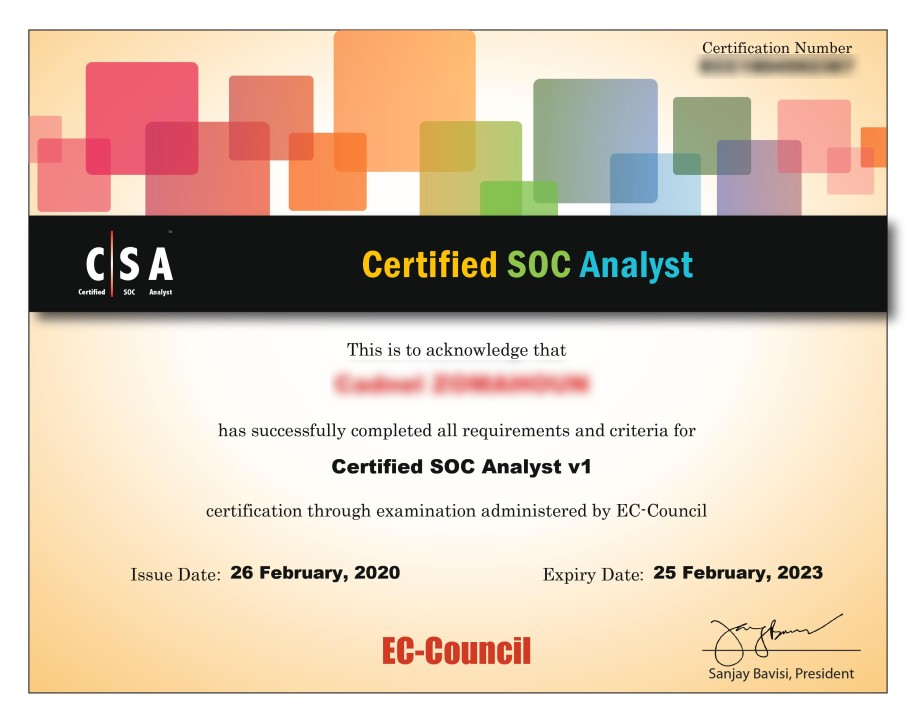
Validate your SOC analyst skills in monitoring, detecting, and responding to security incidents through the Certified SOC Analyst (CSA) 24-hour practical assessment.
CSA proves your capability to monitor networks, detect and investigate threats, and respond to security incidents effectively using SOC operations and SIEM tools.
We cover all the aspects related to Certified SOC Analyst Training so that you can gain an understanding of different concepts that can help you crack the exams without any hassle. With us, you don’t have to worry about the charges as well. We are highly acclaimed in the business when it comes to providing Certified SOC Analyst courses at such low rates.Take a look at what we have covered in our Certified SOC Analyst Course content:
Learn how a SOC enhances an organization’s security management to maintain a strong security posture, focusing on the critical roles of people, technology, and processes in its operations.
Key topics covered:SOC, SOC Capabilities, SOC Operations,SOC Workflow, Components of SOC, SOC Models, SOC Maturity Models, SOC Generations, SOC KPIs and Metrics, SOC Challenges
Learn various cyberattacks, their IoCs, and the attack tactics, techniques, and procedures (TTPs) cybercriminals use.
Hands-on labs:
Key topics covered:Cyber Threats, TTPs, Reconnaissance Attacks, Man-in-the-Middle Attacks, Password Attack Techniques, Malware Attacks, Advanced Persistent Threat Lifecycle, Host-Based DoS Attacks, Ransomware Attacks, SQL Injection Attacks, XSS Attacks, Cross-Site Request Forgery (CSRF) Attack, Session Attacks, Social Engineering Attacks, Email Attacks, Insider Attack, IoCs, Attacker’s Hacking Methodology, MITRE D3FEND Framework, Diamond Model of Intrusion Analysis
Learn log management in SIEM, including how logs are generated, stored, centrally collected, normalized, and correlated across systems.
Hands-on labs:
Key topics covered: Incident, Event, Log, Log Sources, Log Format, Local Logging, Windows Event Log, Linux Logs, Mac Logs, Firewall Logs, iptables, Router Logs,IIS Logs, Apache Logs, Database Logs, Centralized Logging,Log Collection, Log Transmission, Log Storage, AI-Powered Script for Log Storage, Log Normalization, Log Parsing, Log Correlation, Log Analysis,Alerting and Reporting
Learn SIEM fundamentals, including its capabilities, deployment strategies, use case development, and how it helpsSOC analysts detect anomalies, triage alerts, and report incidents.
Hands-on labs:
Key topics covered:SIEM, SIEM Architecture and Its Components, AI-Enabled SIEM, Types of SIEM Solutions, SIEM Deployment, SIEM Use Cases, SIEM Deployment Architecture, SIEM Use Case Lifecycle,Application-Level Incident Detection SIEM Use Cases, Insider Incident Detection SIEM Use Cases, Examples of Network Level Incident Detection SIEM Use Cases, Examples of Compliance Use Cases, SIEM Rules Generation with AI, Alert Triage, Splunk AI, Elasticsearch AI, Alert Triage with AI, Dashboards in SOC, SOC Reports
Learn the importance of threat intelligence and threat hunting for SOC analysts, and how their integration with SIEM helps reduce false positives and enables faster, more accurate alert triage.
Hands-on labs:
Key topics covered:Cyber Threat Intelligence (CTI),Threat Intelligence Lifecycle, Types of Threat Intelligence, Threat Intelligence Strategy, Threat Intelligence Sources, Threat Intelligence Platform (TIP), Threat Intelligence-Driven SOC, Threat Intelligence Use Cases for Enhanced Incident Response, Enhanced Threat Detection with AI, Threat Hunting, Threat Hunting Process, Threat Hunting Frameworks, Threat Hunting with PowerShell Script, PowerShell AI Module, Threat Hunting with AI, Threat Hunting with YARA, Threat Hunting Tools
Learn the stages of incident response and how the IRT collaborates with SOC to handle and respond to escalated incidents.
Hands-on labs:
Key topics covered:Incident Response (IR), IRT, SOC and IRT Collaboration, IR Process, Ticketing System, Incident Triage, Notification, Containment, Eradication, Recovery, Network Security Incident Response, Application Security Incident Response, Email Security Incident Response, Insider Threats and Incident Response, Malware Threats and Incident Response, SOC Playbook, Endpoint Detection and Response (EDR), Extended Detection and Response (XDR), SOAR, SOAR Playbook


Learn the importance of forensic investigation and malware analysis in SOC operations to understand attack methods, identify IoCs, and enhance future defenses.
Hands-on labs:
Key topics covered:Forensics Investigation, Forensics Investigation Methodology, Forensics Investigation Process, Forensics Investigation of Network Security Incidents, Forensics Investigation of Application Security Incidents, Forensics Investigation of Email Security Incidents, Forensics Investigation of Insider Incidents, Malware Analysis, Types of Malware Analysis, Malware Analysis Tools, Static Malware Analysis, Dynamic Malware Analysis
Learn the SOC processes in cloud environments, covering monitoring, incident detection, automated response, and security in AWS, Azure, and GCP using cloud-native tools.
Hands-on Labs:
Key topics covered:Cloud SOC, Azure SOC Architecture, Microsoft Sentinel, AWS SOC Architecture, AWS Security Hub, Centralized Logging with OpenSearch, Google Cloud Platform (GCP) Security Operation Center, Security Command Center, Chronicle
Trusted Partners
Organisations across banking, government, fintech, consulting and energy trust Securium Academy to train their security teams.


Recognition
Independent recognition for the quality of our training, labs and learner outcomes.
The Certified SOC Analyst (CSA) training course is a comprehensive program that equips participants with the skills and knowledge needed to effectively monitor and respond to security incidents within a Security Operations Center (SOC) environment.

Yes, the certified SOC analyst course is designed to cater to participants with varying levels of experience. While some familiarity with networking and cybersecurity basics is helpful, beginners can still benefit from the course’s comprehensive approach and hands-on training.
The primary objectives of the CSA training course in India are to equip participants with the necessary skills to proactively identify and respond to security incidents, effectively analyze security data, and implement best practices within a SOC environment.
Absolutely! The CSA certification can open doors to advanced roles in cybersecurity, such as SOC Manager, Security Analyst Lead, or Incident Response Team Lead, depending on your experience and expertise.
Absolutely! The CND V2 certification course is regularly updated to include the latest industry trends, emerging cyber threats, and best practices in network defense.
Yes, the CSA training course often covers threat intelligence concepts and its vital role in enhancing SOC operations, including how to leverage threat intelligence feeds for proactive defense.
CSA training course in UAE covers a wide range of topics, including SOC fundamentals, threat intelligence, incident management, log management, network traffic analysis, and security event correlation.
The CSA training course is ideal for security professionals, SOC analysts, network administrators, and anyone involved in security operations seeking to enhance their incident handling and response capabilities.