—Master Practical Penetration Testing. Prepare for the OSCP+ Certification.
OSCP (PEN-200) The Industry-Leading Penetration Testing Course Gain real-world offensive security experience with a lab-driven, practical course. Learn from expert instructors, complete hands-on exercises, and earn a globally recognized certification.
Master practical penetration testing through structured, hands-on OSCP+ certification training, expert mentorship and real-world security exercises.
🎯
Practical Penetration Testing
📋
OSCP+ Exam Preparation
🌐
Active Directory Labs
💻
Simulated Lab Practice
👨🏫
Expert Mentorship
📄
Professional Reporting
Why Choose Why Choose OSCP+??
Why Choose OSCP+ Certification Training?
The Offensive Security Certified Professional Plus (OSCP+) certification validates practical penetration testing capabilities through a challenging, hands-on examination. It focuses on identifying vulnerabilities, gaining access to systems, escalating privileges and documenting security findings.
Unlike certifications focused primarily on theoretical knowledge, OSCP+ emphasizes practical problem-solving and the ability to perform penetration testing in realistic environments.
With Securium Academy's OSCP+ training, you can:
Develop Practical Expertise
Strengthen your ability to identify vulnerabilities and perform penetration testing across different environments.
Master Advanced Techniques
Learn exploitation, privilege escalation, Active Directory attacks and network pivoting.
Prepare with Structured Learning
Follow a focused curriculum designed around practical penetration testing competencies.
Strengthen Career Opportunities
Build technical capabilities relevant to penetration testing, red teaming and offensive security roles.
The PEN-200 course prepares you for the OSCP exam: a 24-hour practical test where you must compromise multiple machines and submit a professional report. Exam format: 24-hour hands-on exam + 24-hour report submission window. Passing criteria: Achieve the required points by exploiting targets and producing a clear, reproducible report. Re-take policy & exam vouchers: Details depending on enrollment package. Score tracking & exam prep resources provided for focused practice.
Offensive Security Certified Professional Plus (OSCP+)
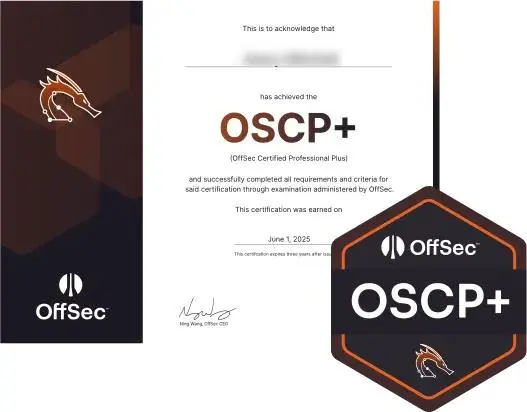
The OSCP+ certification from OffSec is a practical, performance-based cybersecurity credential designed to evaluate real-world penetration testing skills.
The PEN-200 course covers essential offensive security techniques, including information gathering, vulnerability discovery, exploitation, privilege escalation, Active Directory attacks and penetration testing documentation.
Our OSCP+ Certification Training program is designed to help cybersecurity professionals strengthen their technical foundation, practice exploitation methodologies and prepare for the challenges of the OSCP+ examination.
Through instructor-led guidance, structured learning and practical exercises, learners develop the confidence to approach complex penetration testing scenarios systematically.
Tools & Technologies Covered
Kali Linux
A Linux-based platform for penetration testing, security assessments and ethical hacking.
Nmap
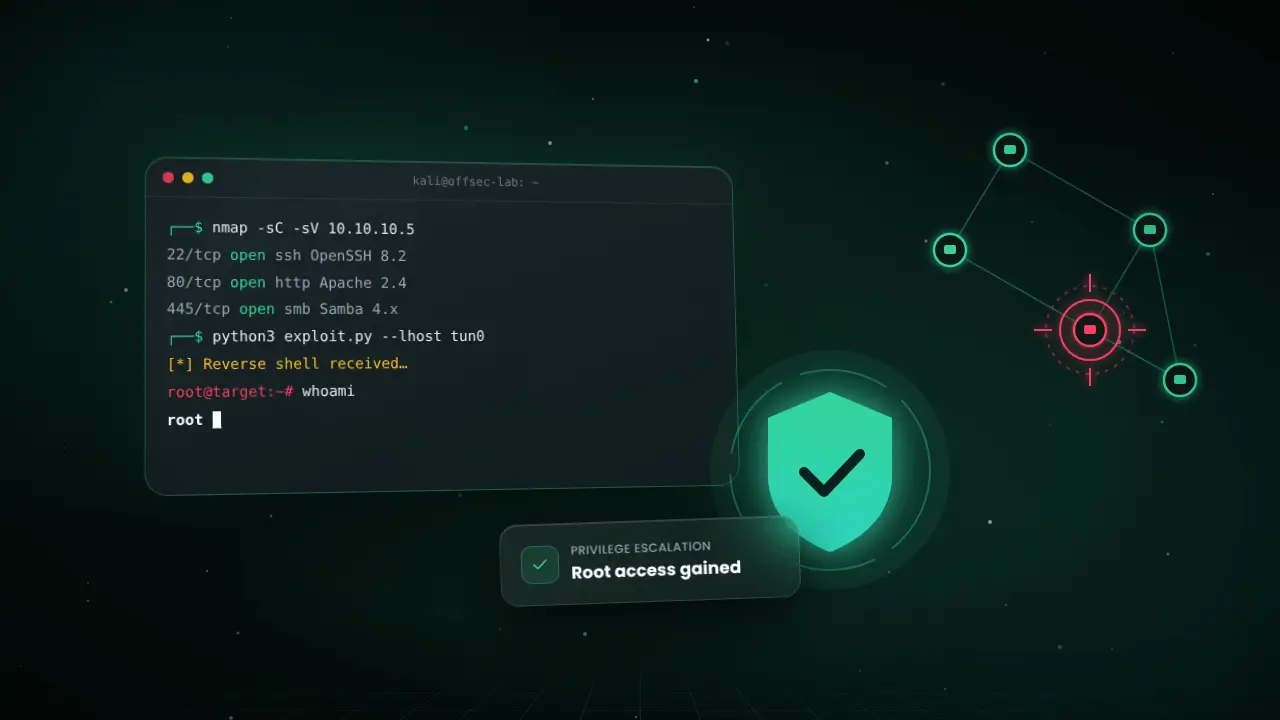
Discover network hosts, scan open ports and identify running services.
Metasploit Framework
Identify vulnerabilities and perform practical exploitation in controlled environments.
Burp Suite
Test web applications, intercept requests and identify security vulnerabilities.
Wireshark
Capture and analyze network traffic to understand communication and security issues.
Netcat
Establish network connections, listen on ports and troubleshoot network communication.
Hydra
Perform authorized password testing and identify weak authentication credentials.
John the Ripper
Analyze password hashes and evaluate password strength through password auditing.
OSCP+ Certification Training is suitable for:
Working cybersecurity professionals looking to advance into penetration testing.
Penetration testers seeking to strengthen their exploitation and privilege escalation skills.
Red team professionals looking to validate their offensive security capabilities.
Network and system administrators transitioning into cybersecurity.
Security analysts interested in developing practical offensive security knowledge.
Ethical hackers preparing for the OSCP+ certification examination.
This is not a beginner-level program. Learners should ideally have:
2–3 years of experience in cybersecurity, IT or information security.
Good understanding of TCP/IP networking concepts.
Working knowledge of Windows and Linux operating systems.
Basic command-line and system administration skills.
Familiarity with scripting languages such as Python or Bash.
Fundamental understanding of penetration testing concepts.
By the end of the training, learners should be able to:
Perform structured reconnaissance and network enumeration.
Identify vulnerabilities and evaluate possible exploitation techniques.
Exploit vulnerable systems using manual and appropriate automated techniques.
Perform Windows and Linux privilege escalation.
Understand and assess Active Directory environments.
Apply pivoting and tunneling techniques during internal network assessments.
Conduct web application penetration testing.
Document penetration testing findings through professional reports.
Course Syllabus
Understanding the OSCP exam structure, lab environment, and reporting guidelines - Note-keeping, documentation, and proof-capturing techniques - Developing the “Try Harder” mentality that defines OffSec professionals
Locating public exploits and understanding exploit adaptation - Building payloads with Msfvenom and Metasploit - Manual exploitation and privilege escalation without automated tools - Real-world scenarios reflecting OffSec lab machines
Deep-dive into OWASP Top 10 vulnerabilities - File inclusion, file upload, directory traversal, and command injection - Manual SQL injection exploitation - Web shell deployment and post-exploitation persistence
Brute-force and password reuse attacks with Hydra, Crackmapexec, Hashcat, John Attacking SSH, RDP, SMB, and other authentication services - Credential harvesting and reuse in internal networks
Enumerating and exploiting cron jobs, SUID binaries, misconfigurations - SSH key and password file abuses Exploiting weak sudo rights, group permissions, & vulnerable kernels - Automation with LinPEAS and Pspy
Creating pivot chains across internal subnets - Dynamic, local, and remote tunneling techniques Tools: Chisel, ProxyChains, SSH tunneling, Ligolo-ng - Lateral movement across hybrid environments
AD enumeration using BloodHound, PowerView, AdRecon - Attacking Kerberos and NTLM authentication Credential dumping (SAM, NTDS.dit, LSASS) - Techniques: Pass-the-Hash, DC Sync, DACL abuse, Group privilege escalation
Crafting professional pentesting reports as per OffSec standards - Highlighting vulnerabilities, impact, and remediation - Structuring proof of exploitation for OSCP exam readiness
OSCP+ Examination Structure
The OSCP+ examination is a proctored, hands-on practical assessment conducted in a controlled lab environment. Candidates must demonstrate their ability to identify vulnerabilities, compromise target systems, escalate privileges and prepare professional penetration testing documentation.
Examination Details:
Certification: Offensive Security Certified Professional Plus (OSCP+)
Training Course: PEN-200
Exam Type: Practical, hands-on examination
Exam Duration: 23 hours and 45 minutes
Report Submission: Additional 24 hours
Exam Environment: Private VPN-based lab
Exam Supervision: Proctored examination
Assessment: Standalone machines and Active Directory environment
Certification Authority: OffSec
Important Examination Information:
Candidates must demonstrate practical penetration testing capabilities.
The examination includes standalone targets and an Active Directory environment.
Candidates must collect the required proof files.
A professional penetration testing report containing screenshots, technical findings and reproducible steps must be submitted.
Examination results and passing criteria follow the applicable OffSec examination rules.
Passing Score Update:
Exams starting before December 1, 2026 use the existing 70/100 passing score.
Exams starting on or after December 1, 2026 will use equated scaled scoring, with 400 as the passing score on a 100–500 scale.
Student Reviews
The OSCP course exceeded my expectations with challenging labs, and mentors were always available to guide and support throughout the entire learning process.
Sridhar V
The hands-on learning approach helped me successfully clear the OSCP exam, with detailed sessions that were practical, engaging, and easy to understand.
Kunal Rajput
The mentorship and practical approach made learning extremely effective, helping me build strong real-world penetration testing skills throughout the entire training program.
Rohit Mehta
Very good experience.They guided us throughout the whole course . I hope to do more courses under their guidance.
Aksh Jolly
The training session was very informative and well-structured. The trainer demonstrated strong subject knowledge and explained security concepts clearly with practical examples. The session was interactive and engaging, making it easy to understand complex topics. Overall, a very valuable learning experience
Ankur Seth
I got a wonderful experience from here as a trainee,
The seniors are very helpful the best thing is that you sit with employees and directly learn from them.
I love that, when I have to pray they provide me personal space for prayer.
Barira Naaz
Excellent training from Securium Academy! The instructors were knowledgeable, the hands-on labs were very helpful, and the course made complex topics easy to understand. Thanks for the great support that helped me pass my CEH exam!
Jishnu Jithesh
I had an excellent experience with Securium Academy! The courses are well-structured, up-to-date, and tailored to meet industry standards, especially in the field of cybersecurity. The instructors are highly knowledgeable and supportive, breaking down complex topics into easily understandable modules. What stood out the most was their hands-on approach with practical labs, real-world scenarios, and continuous mentoring. Whether you're a beginner or looking to advance your career, Securium Academy offers the right blend of theory and practice. Highly recommended for anyone serious about building a strong foundation in cybersecurity!
Lokesh Dandamudi
I recently completed a cybersecurity course with Securium Academy, and it was an outstanding experience. The instructors were highly knowledgeable and made complex topics easy to understand. The course content was up-to-date, covering the latest threats and technologies. Their hands-on labs were invaluable for practical learning, and the support from the staff was exceptional. I feel well-prepared to tackle real-world cybersecurity challenges thanks to this course.
Naveen
I recently had the amazing opportunity to be selected as a winner of the OSCC – OffSec Challenge giveaway by Securium Academy. From the first interaction to the support I received, everything was smooth, professional, and filled with genuine encouragement.
Their dedication to empowering learners and growing the cybersecurity community is truly inspiring. Special thanks to Neha Ma’am and the whole Securium team for making high-quality learning accessible to aspiring professionals like me.
If you're serious about cybersecurity, I highly recommend Securium Academy! 💻
Somnath Adhikary (Chatterjee)
I just completed CEH certification from EC Council trained by Securium Academy and had an excellent experience both during training and examination. I highly recommend them for any looking to get certified.
Viswajith Vinod
I passed my Ethical Hacking exam successfully with the help of Securium Academy. The training was clear, practical, and well-organized. Great mentors and hands-on labs — highly recommend for anyone preparing for cybersecurity exams.
Akhina
Happy to share that I have successfully earned the Certified Ethical Hacker (CEH) certification from EC-Council! This achievement has deepened my understanding of ethical hacking methodologies, penetration testing, and advanced cybersecurity concepts — empowering me to identify, analyze, and secure systems against evolving cyber threats.
Alka Sajeevan P
Securium Academy provided excellent support throughout my certification journey, with structured training and knowledgeable mentors who made the entire process smooth and effective.
Ankit Yadav
I Had a great experience with Securium Solutions .The CEH training was clear, practical, and really helped me understand cybersecurity better.I would Totally recommend it to anyone interested in ethical hacking
Aswin P
I’m excited to share that I recently completed my Certified Ethical Hacker (CEH) training with Securium Academy and successfully passed the exam! The entire experience was exceptional — the trainers were highly knowledgeable, patient, and always ready to explain concepts using practical, real-world examples.
Devika Vijayan
I had an excellent experience with the CEH training and exam here. The training sessions were very informative, hands-on, and well-structured - covering both theoretical and practical aspects of ethical hacking. The trainers were knowledgeable, supportive, and explained complex topics in a clear way. The lab exercises helped a lot in understanding real-world attack and defense techniques. The exam process was smooth and professionally managed, with quick result updates. Overall, a great place for anyone looking to get CEH certified and build strong cybersecurity skills.
Harshith T V
The OSCP course exceeded my expectations with challenging labs, and mentors were always available to guide and support throughout the entire learning process.
Sridhar V
The hands-on learning approach helped me successfully clear the OSCP exam, with detailed sessions that were practical, engaging, and easy to understand.
Kunal Rajput
The mentorship and practical approach made learning extremely effective, helping me build strong real-world penetration testing skills throughout the entire training program.
Rohit Mehta
Very good experience.They guided us throughout the whole course . I hope to do more courses under their guidance.
Aksh Jolly
The training session was very informative and well-structured. The trainer demonstrated strong subject knowledge and explained security concepts clearly with practical examples. The session was interactive and engaging, making it easy to understand complex topics. Overall, a very valuable learning experience
Ankur Seth
I got a wonderful experience from here as a trainee,
The seniors are very helpful the best thing is that you sit with employees and directly learn from them.
I love that, when I have to pray they provide me personal space for prayer.
Barira Naaz
Excellent training from Securium Academy! The instructors were knowledgeable, the hands-on labs were very helpful, and the course made complex topics easy to understand. Thanks for the great support that helped me pass my CEH exam!
Jishnu Jithesh
I had an excellent experience with Securium Academy! The courses are well-structured, up-to-date, and tailored to meet industry standards, especially in the field of cybersecurity. The instructors are highly knowledgeable and supportive, breaking down complex topics into easily understandable modules. What stood out the most was their hands-on approach with practical labs, real-world scenarios, and continuous mentoring. Whether you're a beginner or looking to advance your career, Securium Academy offers the right blend of theory and practice. Highly recommended for anyone serious about building a strong foundation in cybersecurity!
Lokesh Dandamudi
I recently completed a cybersecurity course with Securium Academy, and it was an outstanding experience. The instructors were highly knowledgeable and made complex topics easy to understand. The course content was up-to-date, covering the latest threats and technologies. Their hands-on labs were invaluable for practical learning, and the support from the staff was exceptional. I feel well-prepared to tackle real-world cybersecurity challenges thanks to this course.
Naveen
I recently had the amazing opportunity to be selected as a winner of the OSCC – OffSec Challenge giveaway by Securium Academy. From the first interaction to the support I received, everything was smooth, professional, and filled with genuine encouragement.
Their dedication to empowering learners and growing the cybersecurity community is truly inspiring. Special thanks to Neha Ma’am and the whole Securium team for making high-quality learning accessible to aspiring professionals like me.
If you're serious about cybersecurity, I highly recommend Securium Academy! 💻
Somnath Adhikary (Chatterjee)
I just completed CEH certification from EC Council trained by Securium Academy and had an excellent experience both during training and examination. I highly recommend them for any looking to get certified.
Viswajith Vinod
I passed my Ethical Hacking exam successfully with the help of Securium Academy. The training was clear, practical, and well-organized. Great mentors and hands-on labs — highly recommend for anyone preparing for cybersecurity exams.
Akhina
Happy to share that I have successfully earned the Certified Ethical Hacker (CEH) certification from EC-Council! This achievement has deepened my understanding of ethical hacking methodologies, penetration testing, and advanced cybersecurity concepts — empowering me to identify, analyze, and secure systems against evolving cyber threats.
Alka Sajeevan P
Securium Academy provided excellent support throughout my certification journey, with structured training and knowledgeable mentors who made the entire process smooth and effective.
Ankit Yadav
I Had a great experience with Securium Solutions .The CEH training was clear, practical, and really helped me understand cybersecurity better.I would Totally recommend it to anyone interested in ethical hacking
Aswin P
I’m excited to share that I recently completed my Certified Ethical Hacker (CEH) training with Securium Academy and successfully passed the exam! The entire experience was exceptional — the trainers were highly knowledgeable, patient, and always ready to explain concepts using practical, real-world examples.
Devika Vijayan
I had an excellent experience with the CEH training and exam here. The training sessions were very informative, hands-on, and well-structured - covering both theoretical and practical aspects of ethical hacking. The trainers were knowledgeable, supportive, and explained complex topics in a clear way. The lab exercises helped a lot in understanding real-world attack and defense techniques. The exam process was smooth and professionally managed, with quick result updates. Overall, a great place for anyone looking to get CEH certified and build strong cybersecurity skills.
Harshith T V
One of the best OSCP training programs available, offering real-world labs and outstanding mentor support that significantly improved my practical cybersecurity skills.
Keshav Singh
The course structure was well-organized and highly effective, allowing me to confidently prepare and successfully clear the OSCP exam on my first attempt.
Amit Reddy
The exam experience was best and also it was conforting environment. This experience with this team was best for achieving any EC council exams or any type of exams . I highly recommend this for any exams
Abhinandh P Narayan
I just completed CEH certification from EC Council trained by Securium Academy and had an excellent experience both during training and examination. I highly recommend them for any looking to get certified.
Anirudh A
I would like to share that I’ve individually enrolled into their courses and I personally want to acknowledge that it has been a great experience overall working with the group. Everything went so smoothly, no hassle whatsoever. Must Recommended for cyber security certifications.
Avinash Shandilya
I recently completed my Certified Ethical Hacker (CEH) training and exam with Securium Solutions, and it was a great learning experience. The sessions were interactive, the instructors were very supportive, and the course content was well structured. I’m really happy with the guidance and practical exposure I received throughout the training. Highly recommended for anyone looking to build a career in cybersecurity
Deepnitha R
Exam was very nice.. It was an excellent experience.. I highly recommend everyone who is highly passionate in cyber security field should attend this exam
Lajin C P
Exam was Nyc. it was a wonderful experience
MATHEW GEORGE
I’m delighted to share that I’ve successfully completed my Certified Ethical Hacker (CEH) certification with Securium Solutions! The training sessions were well-structured, interactive, and extremely informative. I truly appreciate the constant guidance and support from the instructors throughout the course. Highly recommended for anyone looking to build a strong foundation in cybersecurity!
Sandra KV
I recently completed my Certified Ethical Hacker (CEH) training with Securium Solutions, and I’m extremely happy with the experience!
The trainers were knowledgeable, patient, and explained every concept in a simple and practical way. The hands-on labs and real-world examples made learning ethical hacking both interesting and effective. The support team was also very responsive and guided me throughout the certification process.
Thanks to Securium Solutions private limited excellent training, I successfully cleared my CEH exam! I highly recommend them to anyone who wants to build a strong foundation in cybersecurity and ethical hacking.
sreelakshmi vjec
Oscp training and guidance is very good and well formatted. Trainer was osep. Shabaaz the onboarding guide is very helpful.
Adin Dias
This is an excellent cybersecurity training institute! As I attended the workshop, I can say the instructors are industry experts, and the course content is up-to-date, practical, and easy to follow. They provide great hands-on labs and strong support throughout. Highly recommended for anyone serious about a career in cybersecurity!
Akshay Kumar
Happy to share that I have successfully earned the Certified Ethical Hacker (CEH) certification from EC-Council!
This achievement has deepened my understanding of ethical hacking methodologies, penetration testing, and advanced cybersecurity concepts — empowering me to identify, analyze, and secure systems against evolving cyber threats.
I’d like to express my sincere gratitude to Securium Academy for their exceptional training and guidance throughout this learning journey.
Alka Sajeevan P
Grateful to EC-Council for the opportunity to earn my Certified Ethical Hacker (CEH) certification! The course was insightful and well-structured, helping me strengthen my cybersecurity fundamentals.
Special thanks to Mr. Ivan Das for his great mentorship and Ms. Aswathy Mohan for her constant support throughout the journey.
ANUGRAHA K ANIL
I had a great experience with Securium Academy. The trainers are highly knowledgeable and teach really well. My trainer, in particular, stood out with his deep understanding of Cyber Security and strong practical skills. It's also a plus that they provide certification coupons.
Devesh
I recently completed Offensive Security Certified Professional. Securium handled the program well and they have got world class trainers. I was able to crack the exam with their guidance and training. The knowledge that the trainer has is mind blowing and they way he taught us and made us understand is what made me clear the exam. On any given day I would recommend Securium for cyber security related certifications to anyone. Thanks a ton for helping me attain this milestone in my career
Special thanks to Owner Sunil and trainer sunil for mentoring me.
dinesh kumar
One of the best OSCP training programs available, offering real-world labs and outstanding mentor support that significantly improved my practical cybersecurity skills.
Keshav Singh
The course structure was well-organized and highly effective, allowing me to confidently prepare and successfully clear the OSCP exam on my first attempt.
Amit Reddy
The exam experience was best and also it was conforting environment. This experience with this team was best for achieving any EC council exams or any type of exams . I highly recommend this for any exams
Abhinandh P Narayan
I just completed CEH certification from EC Council trained by Securium Academy and had an excellent experience both during training and examination. I highly recommend them for any looking to get certified.
Anirudh A
I would like to share that I’ve individually enrolled into their courses and I personally want to acknowledge that it has been a great experience overall working with the group. Everything went so smoothly, no hassle whatsoever. Must Recommended for cyber security certifications.
Avinash Shandilya
I recently completed my Certified Ethical Hacker (CEH) training and exam with Securium Solutions, and it was a great learning experience. The sessions were interactive, the instructors were very supportive, and the course content was well structured. I’m really happy with the guidance and practical exposure I received throughout the training. Highly recommended for anyone looking to build a career in cybersecurity
Deepnitha R
Exam was very nice.. It was an excellent experience.. I highly recommend everyone who is highly passionate in cyber security field should attend this exam
Lajin C P
Exam was Nyc. it was a wonderful experience
MATHEW GEORGE
I’m delighted to share that I’ve successfully completed my Certified Ethical Hacker (CEH) certification with Securium Solutions! The training sessions were well-structured, interactive, and extremely informative. I truly appreciate the constant guidance and support from the instructors throughout the course. Highly recommended for anyone looking to build a strong foundation in cybersecurity!
Sandra KV
I recently completed my Certified Ethical Hacker (CEH) training with Securium Solutions, and I’m extremely happy with the experience!
The trainers were knowledgeable, patient, and explained every concept in a simple and practical way. The hands-on labs and real-world examples made learning ethical hacking both interesting and effective. The support team was also very responsive and guided me throughout the certification process.
Thanks to Securium Solutions private limited excellent training, I successfully cleared my CEH exam! I highly recommend them to anyone who wants to build a strong foundation in cybersecurity and ethical hacking.
sreelakshmi vjec
Oscp training and guidance is very good and well formatted. Trainer was osep. Shabaaz the onboarding guide is very helpful.
Adin Dias
This is an excellent cybersecurity training institute! As I attended the workshop, I can say the instructors are industry experts, and the course content is up-to-date, practical, and easy to follow. They provide great hands-on labs and strong support throughout. Highly recommended for anyone serious about a career in cybersecurity!
Akshay Kumar
Happy to share that I have successfully earned the Certified Ethical Hacker (CEH) certification from EC-Council!
This achievement has deepened my understanding of ethical hacking methodologies, penetration testing, and advanced cybersecurity concepts — empowering me to identify, analyze, and secure systems against evolving cyber threats.
I’d like to express my sincere gratitude to Securium Academy for their exceptional training and guidance throughout this learning journey.
Alka Sajeevan P
Grateful to EC-Council for the opportunity to earn my Certified Ethical Hacker (CEH) certification! The course was insightful and well-structured, helping me strengthen my cybersecurity fundamentals.
Special thanks to Mr. Ivan Das for his great mentorship and Ms. Aswathy Mohan for her constant support throughout the journey.
ANUGRAHA K ANIL
I had a great experience with Securium Academy. The trainers are highly knowledgeable and teach really well. My trainer, in particular, stood out with his deep understanding of Cyber Security and strong practical skills. It's also a plus that they provide certification coupons.
Devesh
I recently completed Offensive Security Certified Professional. Securium handled the program well and they have got world class trainers. I was able to crack the exam with their guidance and training. The knowledge that the trainer has is mind blowing and they way he taught us and made us understand is what made me clear the exam. On any given day I would recommend Securium for cyber security related certifications to anyone. Thanks a ton for helping me attain this milestone in my career
Special thanks to Owner Sunil and trainer sunil for mentoring me.
OSCP Certification Training | Student Feedback | Securium Academy
OSCP Certification Training | Student Testimonials | Securium Academy
From Theory to Real-World Cybersecurity
45 Days. Real Websites. Real Vulnerabilities. 🔐 | Archit’s Cybersecurity Journey
Real Learner. Real Projects. Real Cybersecurity Skills 🔐 | Securium Academy
Frequently Asked Questions
OSCP (Offensive Security Certified Professional) is a hands-on ethical hacking certification that tests your ability to identify, exploit, and report vulnerabilities in real-world scenarios.
Most learners take 2–4 months of focused study to prepare, depending on prior experience in penetration testing and Linux fundamentals.
While OSCP is an advanced-level certification, beginners with solid networking, Linux, and scripting knowledge can succeed with proper training and practice labs.
OSCP-certified professionals often work as Penetration Testers, Security Analysts, Red Team Members, or Vulnerability Assessors in top cybersecurity firms.
Yes! You’ll get real-world simulated labs and mentorship support to help you practice exploitation, privilege escalation, and reporting techniques.
Candidates should ideally have 2–3 years of experience in cybersecurity or IT, knowledge of TCP/IP networking, familiarity with Linux and Windows, and basic scripting skills.
The training covers reconnaissance, network enumeration, vulnerability exploitation, web application penetration testing, Windows and Linux privilege escalation, Active Directory attacks, pivoting, tunneling and professional reporting.
The examination is a proctored, practical assessment conducted in a private lab environment. Candidates have 23 hours and 45 minutes to complete the examination, followed by an additional 24 hours for report submission.
Yes. The program includes practical exercises and simulated lab-based learning to help candidates understand penetration testing methodologies and apply technical skills.
Relevant career paths include Penetration Tester, Offensive Security Consultant, Red Team Operator, Vulnerability Assessment Analyst and Security Consultant. Job eligibility depends on experience and technical capabilities.
No. Securium Academy provides training and exam preparation. The official OSCP+ certification is awarded by OffSec after a candidate successfully passes its examination.
Exam voucher inclusion depends on the selected enrollment package. Candidates should confirm the package details with the Securium Academy admissions team before enrolling.