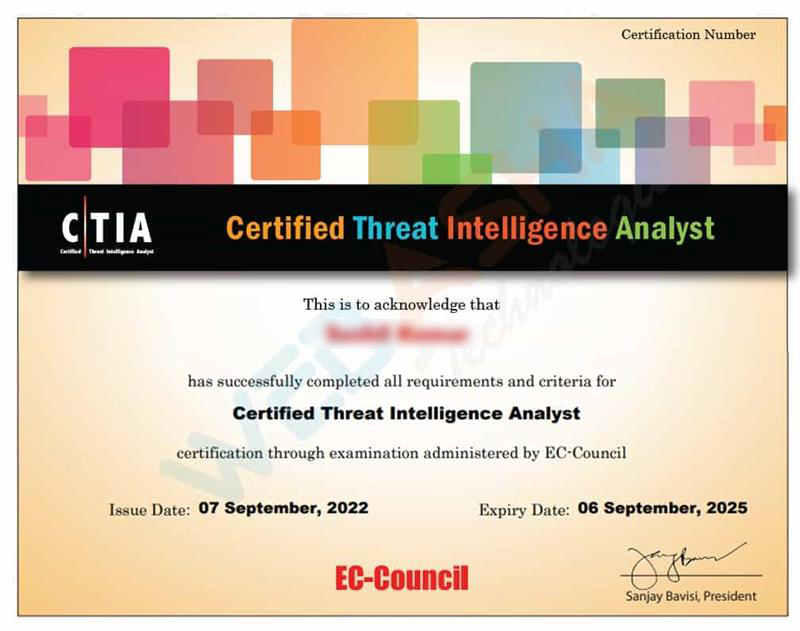
CTIA equips you with the skills to collect, analyze, and operationalize threat intelligence to proactively defend against cyber-attacks and strengthen organizational security posture.

Speak with our admissions team about CTIA.
Certified Threat Intelligence Analyst — master cyber threat intelligence lifecycle, adversary profiling, dark web intelligence, malware behavior analysis, and SOC-ready threat reporting for modern defensive operations.
Validate your advanced penetration testing skills including exploit development, Active Directory exploitation, pivoting & cloud attacks through EC-Council CTIA 24-hour practical exam.
CTIA proves your capability to execute advanced enterprise-level attacks, breach real segmented networks, and produce professional red team reports.
Successful completion of the CTIA training program empowers you with across the board understanding of
The CTIA certification course from Securium Academy assists you to gain a proper understanding of threat intelligence and core concepts. It helps you gain an appropriate understanding of different types of cyber threats. So, if you are thinking about pursuing this course, then we are here to assist you with the same. With us, you never have to stress about the charges. Our CTIA threat intelligence analyst certification course fee are quite low. It ensures that everyone who desires to can pursue the course without having any burden on their wallets. Take a look at the outline of the Certified Threat Intelligence Analyst Course:
Key topics covered:
Cyber Threat Intelligence, Threat Intelligence vs. Threat Data, Threat Intelligence vs. Traditional Cybersecurity Approaches, Types of Threat Intelligence, Threat Intelligence Generation, Responsibilities of Cyber Threat Analysts, Threat Intelligence Lifecycle, Threat Intelligence Strategy,
Threat Intelligence Maturity Model, Threat Intelligence Frameworks, Threat Intelligence Platforms (TIPs), Role of Threat Intelligence in Cloud Security, and Career Paths and Opportunities in Threat Intelligence Field
Key topics covered:
Cyber Threats, Cyber Security Threat Categories, Threat Actors, Objectives of Cyber Security Attacks, Advanced Persistent Threats, Advanced Persistent Threat Lifecycle, Cyber Kill Chain Methodology, MITRE ATT&CK Framework, Diamond Model of Intrusion Analysis, Indicators of Compromise, Categories of Indicators of Compromise, and Pyramid of Pain
Key topics covered:
Identify Critical Threats to the Organization, Threat Intelligence Requirements, MoSCoW Method for Prioritizing Requirements, Scope of Threat Intelligence Program, Rules of Engagement, Threat Intelligence Program Planning, Project Charter and Policy Preparation, Threat Intelligence Roles and Responsibilities, Build Intelligence Team, Threat Intelligence Sharing, Types of Sharing Partners, and Threat Intelligence-led Engagement Review
Key topics covered:
Threat Intelligence Data Collection, Data Collection Methods, Types of Data, Types of Threat Intelligence Data Collection, Threat Intelligence Collection Plan, Threat Intelligence Feeds, Threat Intelligence Sources, Threat Intelligence Data Collection and Acquisition, Data Collection through Python Scripting, Bulk Data Collection, Bulk Data Management, Data Processing and Exploitation, Structuring/Normalization of Collected Data, Data Sampling, and Threat Data Collection in Cloud Environments
Labs:
Key topics covered:
Data Analysis, Types of Data Analysis, Statistical Data Analysis, Analysis of Competing Hypotheses (ACH), Structured Analysis of Competing Hypotheses (SACH), Threat Analysis, Types of Threat Intelligence Analysis, Threat Analysis Process, Threat Modeling Methodologies, Threat Analysis Process with Diamond Model Framework, Validating and Prioritizing Threat Indicators, Fine-Tuning Threat Analysis, Automate Threat Analysis Processes, Threat Intelligence Evaluation, Threat Attribution, Creating Runbooks, Threat Knowledge Base, and Threat Intelligence Tools
Labs:
Key topics covered:
Threat Intelligence Reports, Types of Cyber Threat Intelligence Reports, Report Writing Tools, Dissemination, Threat Intelligence Sharing, Information Sharing Model, Information Exchange Types, Sharing Community, Sharing Intelligence using YARA Rules, Standards and Formats for Sharing Threat Intelligence, Information Sharing and Collaboration Platforms, Intelligence Sharing Acts and Regulations, Threat Intelligence Integration, Threat Intelligence Sharing using Python Scripting
Labs:
Key topics covered:
Threat Hunting, Types of Threat Hunting, Threat Hunting Process, Threat Hunting Maturity Model (HMM), Threat Hunter Skillset, Threat Hunting Loop, Targeted Hunting Integrating Threat Intelligence (TaHiTI), Threat Hunting Automation, and Threat Hunting Automation using Python Scripting
Labs:
Key topics covered:
Threat Intelligence in SOC Operations, Building SOC Threat Intelligence, Next-Gen Intelligent SOC, SOC Threat Intelligence Platforms (TIPs), Threat Intelligence in Risk Management Process, Integrating Threat Intelligence into Risk Management Processes, Threat Intelligence into the Incident Response Process, and Threat Intelligence in Incident Recovery and Resilience
Trusted Partners
Organisations across banking, government, fintech, consulting and energy trust Securium Academy to train their security teams.


Recognition
Independent recognition for the quality of our training, labs and learner outcomes.
The CTIA course is ideal for cybersecurity professionals, SOC analysts, threat hunters, incident responders, digital forensics professionals, security managers, and anyone looking to build expertise in Threat Intelligence. It is also suitable for beginners who want to specialize in analyzing cyber threats and building intelligence-driven defense strategies.
The CTIA course covers all essential stages of threat intelligence, including:
There are no strict prerequisites. However, basic knowledge of cybersecurity, networking concepts, and SOC/incident response processes can be helpful. Even beginners can join since the course starts from foundational concepts and gradually moves to advanced intelligence practices.
Yes, CTIA is a globally recognized certification offered by EC-Council. It is valued by cybersecurity companies, SOCs, consulting firms, government agencies, and threat intelligence units. The certification demonstrates expertise in cyber threat intelligence, making it a strong addition to professional profiles.
The CTIA program is delivered online with instructor-led training, virtual labs, and downloadable study resources. Duration depends on learning speed, but typically takes 20–40 hours. It is flexible for both working professionals and students.
The CTIA exam evaluates skills in:
Professionals with CTIA skills earn an average salary ranging between ₹6 LPA to ₹22 LPA, depending on job role, experience, and organization size. Roles like Threat Analyst, SOC Lead, and Threat Hunter often receive higher packages.
Securium Academy is one of the best online platforms for learning CTIA. It offers expert instructors, hands-on practical labs, real-world threat analysis training, and exam-focused guidance.