—Aggressive Hacker Vibe • AI Labs • Live Red Team
Master real-world pentesting & AI-assisted attack simulations. Live labs, exam mapping, and professional reporting to prepare you for CEH v13.
Speak with our admissions team about CEH v13.
Certified Ethical Hacker v13 — AI-enhanced offensive security training with hands-on red-team labs and real-world exam preparation. CEH v13 upgrades the classic CEH syllabus with AI-powered modules, hands-on red-team labs, and modern attack surface coverage — preparing you for real-world threats and high-impact security roles. Real-world threats and high-impact security roles
AI-powered reconnaissance + precision exploitation executed with stealth & ethical boundaries.
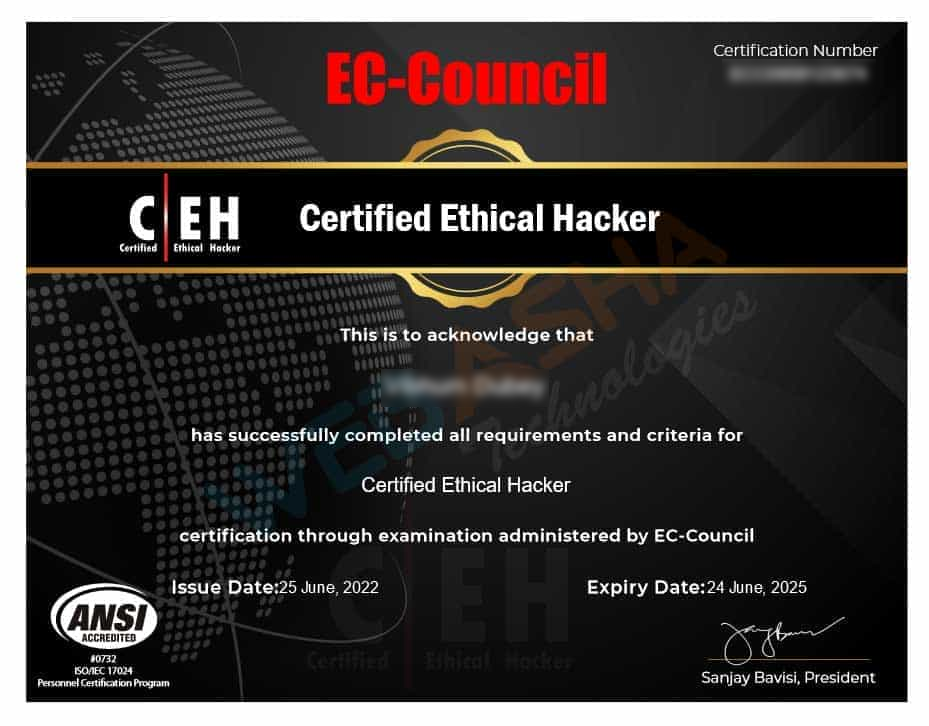
Validate your real-world cyber offense & defense skills with industry-recognized CEH v13 credential under EC-Council.
CEH v13 proves you can break into vulnerabilities ethically and secure systems against the latest cyber threats.
Learn the fundamentals of key issues in the information security world, including the basics of ethical hacking, information security controls, relevant laws, and standard procedures.
Key topics covered:Elements of Information Security, Classification of Attacks, Hacker Classes, Ethical Hacking, AI-Driven Ethical Hacking, ChatGPT-Powered AI Tools for Ethical Hackers, CEH Ethical Hacking Framework, Cyber Kill Chain Methodology, MITRE ATT&CK Framework, Information Assurance (IA), Risk Management, Threat Intelligence Lifecycle, Incident Management, PCI DSS, HIPPA, SOX, GDPR, DPA
Learn how to use the latest techniques and tools to perform footprinting and reconnaissance, a critical pre-attack phase of the ethical hacking process.
Hands-on Labs:
Key topics covered:Reconnaissance, Footprinting Using Advanced Google Hacking Techniques, Footprinting through People Search Services, Dark Web Footprinting, Competitive Intelligence Gathering, Footprinting through Social Networking Sites, Whois Lookup,DNS Footprinting,Traceroute Analysis,Email Footprinting,Footprinting through Social Engineering, AI-Powered OSINT Tools
Learn different network scanning techniques and countermeasures.
Hands-on Labs:
Key topics covered:Network Scanning, Scanning Tools, Host Discovery Techniques, Port Scanning Techniques, Host Discovery and Port Scanning with AI,Service Version Discovery, OS Discovery/Banner Grabbing, Scanning Beyond IDS and Firewall,Scanning Detection and Prevention
Learn various enumeration techniques, including Border Gateway Protocol (BGP) and Network File Sharing (NFS) exploits and associated countermeasures.
Hands-on Labs:
Key topics covered:Enumeration, NetBIOS Enumeration, SNMP Enumeration, LDAP Enumeration, NTP Enumeration, NFS Enumeration, SMTP Enumeration, DNS Cache Snooping, DNSSEC Zone Walking, IPsec Enumeration, VoIP Enumeration, RPC Enumeration, Unix/Linux User Enumeration, SMB Enumeration, Enumeration using AI, Enumeration Countermeasures
Learn how to identify security loopholes in a target organization’s network, communication infrastructure, and end systems. Different types of vulnerability assessment and vulnerability assessment tools are included as well.
Hands-on Labs:
Key topics covered:Vulnerability Classification, Vulnerability Scoring Systems and Databases, Vulnerability-Management Life Cycle, Vulnerability Research, Vulnerability Scanning and Analysis, Vulnerability Assessment Tools, Vulnerability Assessment Reports, AI-Powered Vulnerability Assessment Tools
Learn about the various system hacking methodologies used to discover system and network vulnerabilities, including steganography, steganalysis attacks, and how to cover tracks.
Hands-on Labs:
Key topics covered:Password Cracking, Password Attacks, Password-Cracking Tools, Vulnerability Exploitation, Metasploit Framework, AI-Powered Vulnerability Exploitation Tools, Buffer Overflow, Buffer Overflow Detection Tools, Active Directory (AD) enumeration, Privilege Escalation, Privilege Escalation Tools, Executing Applications, Keylogger, Spyware,Rootkits,Steganography,Steganalysis, Steganography Detection Tools,Maintaining Persistence, Linux and Windows Post Exploitation,Covering Tracks,Clearing Logs,Track-Covering Tools
Learn about different types of malware (Trojan, viruses, worms, etc.), APT and fileless malware, malware analysis procedures, and malware countermeasures.
Hands-on Labs:
Key topics covered:Malware, Advanced Persistent Threat Lifecycle, Trojan,Virus, Ransomware,Computer Worms, Fileless Malware, AI-based Malware, Malware Analysis, Static Malware Analysis, Dynamic Malware Analysis, Virus Detection Methods, Malware Countermeasures, Anti-Trojan Software, AI-Powered Malware Detection and Analysis Tools
Learn about packet-sniffing techniques and their uses for discovering network vulnerabilities, plus countermeasures to defend against sniffing attacks.
Hands-on Labs:
Key topics covered:Network Sniffing, MAC Flooding, DHCP Starvation Attack, ARP Spoofing, ARP Spoofing/Poisoning Tools, MAC Spoofing, VLAN Hopping, STP Attack, DNS Poisoning Techniques, DNS Poisoning Tools, Sniffing Tools, Sniffer Detection Techniques, Promiscuous Detection Tools
Learn social engineering concepts and techniques, including how to identify theft attempts, audit human-level vulnerabilities, and suggest social engineering countermeasures.
Hands-on Labs:
Key topics covered:Social Engineering, Types of Social Engineering, Human-based Social Engineering Techniques, Impersonation, Computer-based Social Engineering Techniques,Phishing, Phishing Tools, Perform Impersonation using AI, Identity Theft, Mobile-based Social Engineering Techniques, Social Engineering Countermeasures, Anti-Phishing Toolbar
Learn about different Denial of Service (DoS) and Distributed DoS (DDoS) attack techniques, plus the tools used to audit a target and devise DoS and DDoS countermeasures and protections.
Hands-on Labs:
Key topics covered:DoS Attack, DDoS Attack, Botnets, DoS/DDoS Attack Techniques, DoS/DDoS Attack Toolkits, DoS/DDoS Attack Detection Techniques, DoS/DDoS Protection Tools, DoS/DDoS Protection Services
Learn the various session hijacking techniques used to discover network-level session management, authentication, authorization, and cryptographic weaknesses and associated countermeasures.
Hands-on Labs:
Key topics covered:Session Hijacking, Application-Level Session Hijacking, Compromising Session IDs, Session Hijacking, Network-Level Session Hijacking, TCP/IP Hijacking, RST Hijacking, Blind Hijacking, Session Hijacking Tools, Session Hijacking Detection Methods, Session Hijacking Detection Tools, Approaches to Prevent Session Hijacking
Learn about firewall, intrusion detection system (IDS), and honeypot evasion techniques; the tools used to audit a network perimeter for weaknesses; and countermeasures.
Hands-on Labs:
Key topics covered:Intrusion Detection System (IDS), Intrusion Prevention System (IPS), Firewall, Types of Firewalls, Intrusion Detection Tools, Intrusion Prevention Tools, IDS/Firewall Evasion Techniques, NAC and Endpoint Security Evasion Techniques, IDS/Firewall Evading Tools, Honeypot, Types of Honeypots, Honeypot Tools, IDS/Firewall Evasion Countermeasures
Learn about web server attacks, including a comprehensive attack methodology used to audit vulnerabilities in web server infrastructures and countermeasures.
Hands-on Labs:
Key topics covered:Web Server Architecture, Web Server Vulnerabilities, Web Server Attacks, DNS Server Hijacking, Web Cache Poisoning Attack, Web Server Footprinting/Banner Grabbing, Directory Brute Forcing, Vulnerability Scanning, Web Server Password Hacking, Web Server Attack Tools, Web Server Attack Countermeasures, Detecting Web Server Hacking Attempts, Web Server Security Tools
Learn about web application attacks, including a comprehensive web application hacking methodology used to audit vulnerabilities in web applications and countermeasures.
Hands-on Labs:
Key topics covered:Web Application, OWASP Top 10 Application Security Risks – 2021, Web Application Attacks, Footprint Web Infrastructure, Analyze Web Applications, Bypass Client-side Controls, Attack Access Controls, Attack Web Services, Web API, Webhooks, Web API Hacking Methodology, API Security Risks and Solutions, Web Application Security Testing,Web Application Fuzz Testing, Encoding Schemes, Web Application Attack Countermeasures, Web Application Security Testing Tools
Learn about SQL injection attack techniques, evasion techniques, and SQL injection countermeasures.
Hands-on Labs:
Key topics covered:SQL Injection, Types of SQL injection, Error Based SQL Injection, Union SQL Injection,Blind/Inferential SQL Injection,SQL Injection Methodology, Information Gathering and SQL Injection Vulnerability Detection, Launch SQL Injection Attacks, Advanced SQL Injection, SQL Injection Tools, SQL Injection with AI, Evasion Techniques, SQL Injection Countermeasures, SQL Injection Detection Tools
Learn about different types of encryption, threats, hacking methodologies, hacking tools, security tools, and countermeasures for wireless networks.
Hands-on Labs:
Key topics covered:Wireless Networks, Wireless Standards, Wireless Encryption, Wireless Threats, Wireless Hacking Methodology, Wi-Fi Discovery, Wireless Traffic Analysis, Launch of Wireless Attacks, Wi-Fi Encryption Cracking, Wireless Attack Countermeasures, Wi-Fi Security Auditing Tools
Learn mobile platform attack vectors, Android and iOS hacking, mobile device management, mobile security guidelines, and security tools.
Hands-on Labs:
Key topics covered:OWASP Top 10 Mobile Risks – 2024,Anatomy of a Mobile Attack, App Sandboxing Issues, SMS Phishing Attack (SMiShing), Call Spoofing, OTP Hijacking/Two-Factor Authentication Hijacking, Camera/Microphone Capture Attacks, Android Rooting, Hacking Android Devices, Android Hacking Tools, Android Security Tools, Jailbreaking iOS, Hacking iOS Devices, iOS Device Security Tools, Mobile Device Management (MDM), OWASP Top 10 Mobile Risks and Solutions, Mobile Security Guidelines, Mobile Security Tools
Learn different types of Internet of Things (IoT) and operational technology (OT) attacks, hacking methodologies, hacking tools, and countermeasures.
Hands-on Labs:
Key topics covered:IoT Architecture, IoT Technologies and Protocols, OWASP Top 10 IoT Threats, IoT Vulnerabilities, IoT Threats, IoT Attacks, IoT Hacking Methodology, IoT Hacking Tools, IoT Security Tools, IT/OT Convergence (IIOT), OT Technologies and Protocols, OT Vulnerabilities, OT Threats, OT Attacks, OT Hacking Methodology, OT Hacking Tools, OT Security Tools
Learn different cloud computing concepts, such as container technologies and serverless computing, various cloud computing threats, attacks, hacking methodologies, and cloud security techniques and tools.
Hands-on Labs:
Key topics covered:Cloud Computing, Fog Computing, Edge Computing, Container, Docker, Kubernetes, Serverless Computing, OWASP Top 10 Cloud Security Risks, Cloud Computing Threats, Container Vulnerabilities, Kubernetes Vulnerabilities, Cloud Attacks, Cloud HackingMethodology, AWS Hacking, Microsoft Azure Hacking, Google Cloud Hacking, Container Hacking, Cloud Network Security, Cloud Security Controls, Cloud Security Tools
Learn about encryption algorithms, cryptography tools, Public Key Infrastructure (PKI), email encryption, disk encryption, cryptography attacks, and cryptanalysis tools.
Hands-on Labs:
Key topics covered:Cryptography, Ciphers, Symmetric Encryption Algorithms, Asymmetric Encryption Algorithms, Message Digest Functions, Quantum Cryptography, Cryptography Tools, Public Key Infrastructure (PKI), Signed Certificate, Digital Signature, Email Encryption, Disk Encryption, Blockchain,Cryptanalysis Methods,Cryptography Attacks, Attacks on Blockchain, Quantum Computing Attacks, Cryptanalysis Tools
Certification is awarded when the knowledge exam is passed. In order to achieve CEH Master Level certification, an additional practical exam needs to be taken. This practical exam is optional.
The Knowledge Exam will test your skills in:
Format
Multiple choice
Duration
4 hours
Questions
125
Delivery
Online via the ECC exam portal
Passing score
60% to 85%
The practical exam is optional but will reward you with a higher level of certification. It will test your practical skills with:

Duration
6 hours
Questions
20 challenges
Delivery
iLabs Cyber Range
Passing score
60% to 85%
Trusted Partners
Organisations across banking, government, fintech, consulting and energy trust Securium Academy to train their security teams.



Recognition
Independent recognition for the quality of our training, labs and learner outcomes.
The demand for skilled cybersecurity professionals is rising faster than ever. As cyber threats evolve and organizations face continuous…
The cybersecurity industry is entering a decisive phase. With increasing cyberattacks, ransomware incidents, and data breaches, organizat…
AIIMS Delhi successfully thwarted a malware attack, protecting sensitive data and critical operations. This marks the second cyber assaul…
In today’s rapidly evolving cybersecurity landscape, ethical hacking and penetration testing have become critical skills for IT professio…
CEH v13 is an ethical hacking certification program recognized around the world. It includes hands-on labs, penetration testing skills, vulnerability assessments, network security fundamentals & AI-powered tools for modern cybersecurity.
CEH v13 includes updated content on AI-driven threats, advanced exploitation techniques, enhanced SOC skills, and deeper hands-on labs compared to v12.
CEH v13 by EC-Council is globally recognized and considered the gold-standard certification to become a professional ethical hacker.
CEH v13 exam has 125 multiple-choice questions (4 hours duration). There is also an optional CEH Practical exam with real penetration testing tasks.
Any IT or cybersecurity enthusiast can enroll. Prior networking & OS knowledge is helpful, but CEH v13 training covers all needed skills.
Global pass rate is ~60-80%. Securium Solutions students achieve up to **95%** pass success due to hands-on training with real lab scenarios.
IT professionals, SOC analysts, cyber enthusiasts, students & job seekers looking to start or advance a cybersecurity career are eligible.
Self-paced: 150-250 hours Instructor-led: 5-10 days depending on batch mode.