Who Should Attend?
- Program Managers & Project Leaders
- Product Managers (AI Products)
- Business Leaders & Decision Makers
- Compliance & Risk Professionals
- Consultants & Transformation Leaders
Speak with our admissions team about CAIMP.

EC-Council Certified AI Program Manager (C|AIPM) equips you with the strategic, governance, and leadership skills required to design, scale, and manage enterprise AI programmes with confidence, compliance, and measurable business impact.
Validate your expertise in AI leadership, governance, and enterprise strategy with EC-Council’s globally recognised CAIPM certification. Learn to manage AI programmes, ensure compliance, and drive real-world AI transformation.
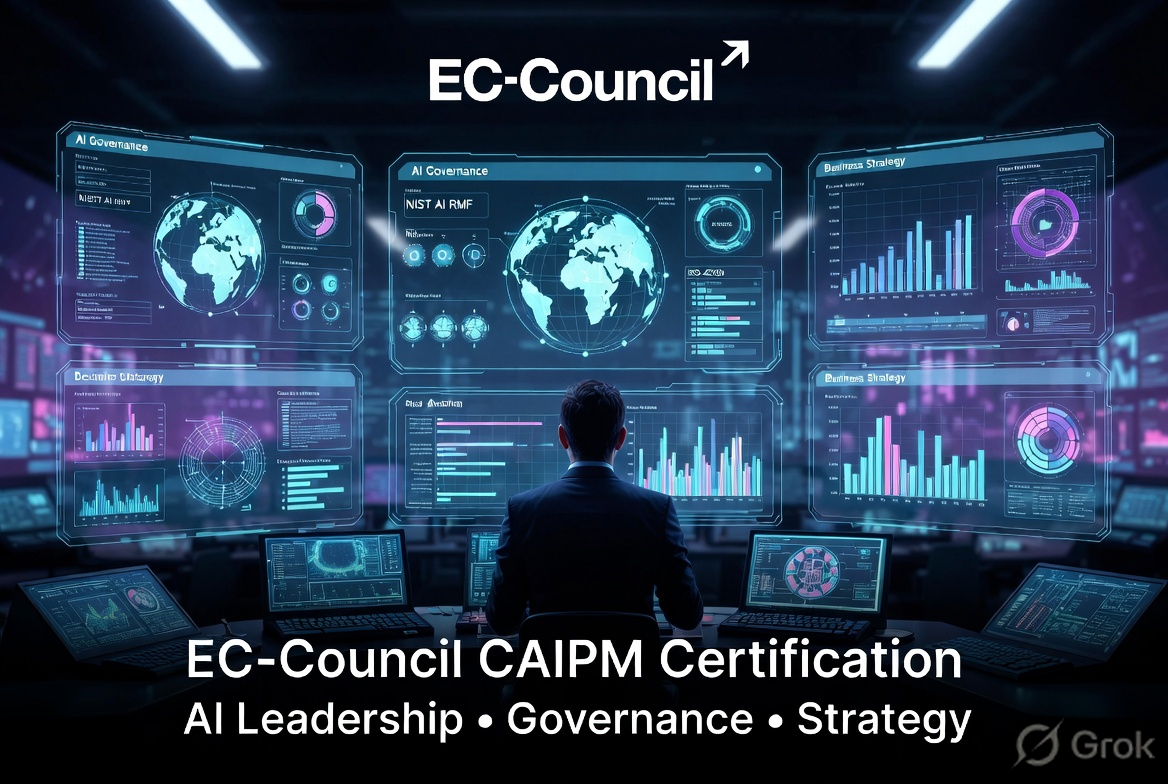
The CAIPM certification validates your ability to lead AI initiatives, manage risk, and implement governance frameworks across enterprise environments. Gain practical knowledge to align AI strategy with business goals and successfully deliver AI programmes at scale.
CAIPM is designed for professionals responsible for driving AI adoption, governance, and strategy within organisations. This is not a technical course for building AI models — it is for leaders who need to manage AI initiatives, align stakeholders, and ensure responsible and scalable AI deployment.
Program Managers & Project Leaders
You are responsible for delivering AI initiatives and need structured frameworks to manage timelines, risks, and cross-team execution.
Product Managers (AI Products)
Learn how to take AI products from concept to production while handling governance, compliance, and stakeholder alignment.
Business Leaders & Decision Makers
Understand how to strategically implement AI across business functions while managing risk, ROI, and regulatory requirements.
Compliance & Risk Professionals
Build expertise in AI governance, regulatory frameworks, and risk management aligned with global standards.
Consultants & Transformation Leaders
Advise organisations on AI adoption strategies and lead large-scale transformation initiatives with confidence.
IT Professionals Moving into AI Leadership
Transition from technical roles into high-impact leadership positions focused on AI strategy and execution.
Design AI programme strategies aligned with business goals and measurable outcomes.
Apply NIST AI RMF and ISO frameworks to manage AI risks, bias, and compliance.
Lead cross-functional teams and deliver AI programmes from concept to production.
Build a strong foundation in AI, ML, and Generative AI, with a clear understanding of how AI differs from automation and analytics, how it is adopted in real businesses, and the trends shaping enterprise AI transformation.
Assess your organization’s readiness for AI adoption by evaluating strategy, data, technology, workforce, and culture, while identifying capability gaps and adoption risks.
Identify, evaluate, and prioritize high-value AI use cases using structured discovery methods, feasibility analysis, and value-based decision frameworks to maximize business impact.
Define an AI strategy aligned with business vision and governance guardrails, and build a prioritized roadmap to guide scalable and accountable AI adoption.
Enable successful AI adoption by leading workforce change, building organizational AI literacy, and applying proven change management frameworks to embed AI into culture and daily operations.
Understand enterprise AI platforms, tools, and ecosystems, and learn how to evaluate, select, and integrate AI solutions securely within organizational IT environments.
Design and implement AI governance, ethical guardrails, and compliance frameworks to ensure responsible, auditable, and mission-ready AI adoption.
Plan, execute, and scale AI pilots into enterprise deployments by applying structured governance, phased rollouts, and risk-aware adoption strategies.
Track AI adoption effectiveness, quantify business value, and communicate measurable impact to stakeholders using data-driven frameworks.
Learn how to embed AI into core business operations by building the leadership, processes, and governance required to sustain long-term AI transformation and value creation.
Trusted Partners
Organisations across banking, government, fintech, consulting and energy trust Securium Academy to train their security teams.
















Recognition
Independent recognition for the quality of our training, labs and learner outcomes.

The Certified AI Program Manager (C|AIPM) is an AI management and leadership certification issued by EC-Council as part of their Enterprise AI Credential Suite launched in February 2026. It sits in the "Adopt" pillar of EC-Council's ADG Framework and is designed for professionals who manage, govern, or lead AI initiatives — rather than those who build or attack AI systems technically.
No. C|AIPM is designed for managers, leaders, and governance professionals rather than engineers. You do not need to know how to build machine learning models. You need to understand AI well enough to lead programmes that include AI components — and this course teaches exactly that.
PMP covers general project management methodology. CAIPM is specifically designed for the unique challenges of AI programme delivery — including AI-specific risk frameworks, regulatory compliance, managing AI engineers and business stakeholders, and operational considerations that do not exist in traditional project management.
The course covers NIST AI RMF, ISO 42001, the EU AI Act, GDPR implications for AI decision-making, and India's Digital Personal Data Protection Act as applied to AI systems. The focus is practical — you will learn what organisations are required to actually implement.
Yes. The course is available in live online format with instructor-led sessions via Zoom. Students receive the same content, case studies, and trainer access as classroom participants in Delhi NCR.
CAIPM prepares you for roles such as AI Programme Manager, AI Governance Manager, Chief AI Officer (CAIO), AI Risk & Compliance Manager, Head of AI Strategy, and Digital Transformation Lead (AI Focus). These roles are rapidly growing across industries like banking, healthcare, government, and technology.